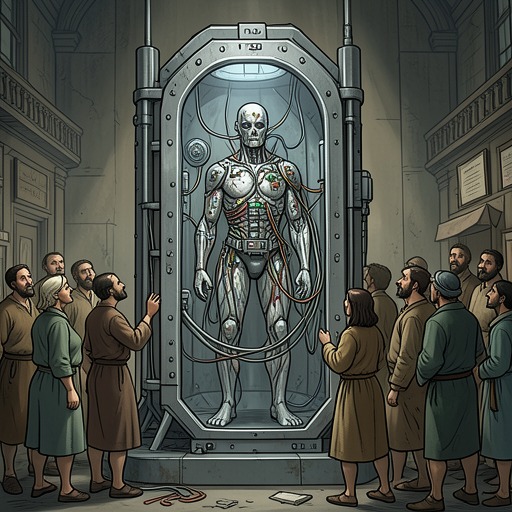
Birth of the First Successful Brain-Man
Last and First MenThe birth of the first successful individual of the Fourth Men marked the culmination of centuries of attempts to create a new kind of human being. Built around an enlarged brain and raised through an exceptionally slow childhood, he became a scientific pioneer whose curiosity eventually made him both the intellectual superior of his teachers and the autocrat of the society that sustained him.
Experiments and Design
After earlier efforts to repeat the experiment had failed, the first true individual of the Fourth Men was produced by the same artificial method as his forerunners, but with more efficient mechanical and chemical systems. His makers adjusted the processes of growth and decay in the hope that he would prove immortal. The project was not simply an attempt to enlarge the brain: it reorganized the brain’s physical setting around a structure devised to accommodate it.
The brain developed into a circular, ferro-concrete turret about forty feet in diameter. Instead of forming normal hemispheres of convolutions, its growing cells spread into compartments prepared for them: partitions radiated from a central space, and the surrounding tiers were lined with small cupboards. Passages connected the outside entrance to the centre and ran between the compartments. Glass, metal, and vulcanite tubes carried blood and chemicals; electric radiators regulated warmth; and thermometers, dials, pressure gauges, and other indicators allowed attendants to monitor the system. The result was a mind housed in a building-sized apparatus, part organism and part carefully serviced factory.
Growth and Education
The new organism’s mental development proceeded far more slowly than his makers had hoped. Eight years after the project began, his brain had filled its room and his mentality had reached that of a newborn infant. He did not attain the standard of a bright adolescent until almost the end of his fifth decade. Yet this prolonged childhood did not predict intellectual weakness: within another decade, he had learned everything the Third Men could teach him and concluded that much of their wisdom was folly.
A government department supervised his upbringing, while an army of learned attendants stood ready to answer questions and help with experiments. Once he reached maturity, the balance reversed. The scholars who had been appointed to instruct him were outclassed and reduced to practical assistance; his most capable helpers became clerks, bottle-washers, and errand-runners. Hundreds of servants searched across the planet for information and specimens, often carrying out requests whose significance they could not understand. Their inability to explain those mysterious tasks did not diminish their public standing: it helped give the staff an air of importance.
Curiosity and the State
Curiosity was his defining drive, joined to a pronounced capacity for making things. His hands were dexterous, and manipulating objects gave him intense pleasure, but he used that ability chiefly to pursue questions and conduct research. At first, he showed no interest in the society that supported him, served his wishes, and revered him. In time, however, he began proposing solutions to problems of social organization. His advice was increasingly requested and followed, until he became autocrat of the state.
His authority rested on more than the people’s reverence. He was intellectually formidable and detached from the ordinary concerns of his subjects, while also possessing a precise, behaviouristic understanding of their responses. He could govern the emotional Third Men without sharing their emotions: rather than openly opposing their admiration of animals and plants or their religion of life, he learned to accommodate those commitments and turn them toward his purposes. The contrast between his inability to sympathize and his skill at anticipating behaviour made his rule unusually secure.
Consequences and Significance
His curiosity reached beyond social management to physics, astronomy, and the study of human nature. He regarded animals as material for experiments, and his disregard for the Third Men’s customary methods of preventing pain both assisted his research and fascinated them. His assurances that the experiments served the improvement of all types helped secure their cooperation; their fascination also exposed a cruelty that, despite their intuitive understanding of animal nature, remained powerful in the Third Men.
The event therefore inaugurates more than a new biological type. It establishes a reversal in which the society that created and educated the brain-centered being becomes dependent on his intellect, while his lack of ordinary fellow-feeling does not prevent him from mastering its social habits. His formation is at once a scientific achievement and the beginning of a new political order, founded on the difference between understanding people and sympathizing with them.